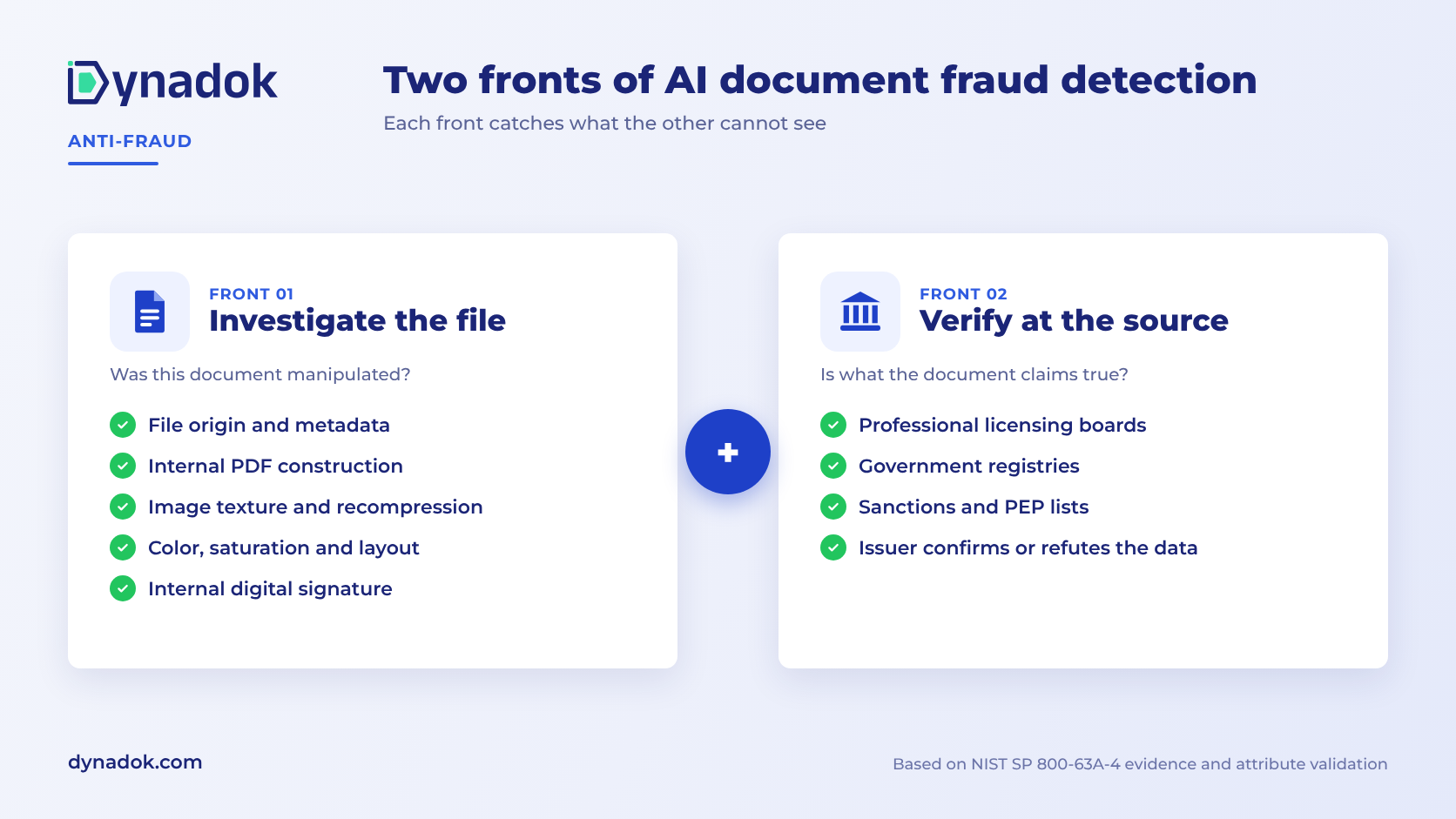
Document fraud detection is the process of confirming that a document is genuine, unaltered and true before a business acts on it. Effective detection combines two checks: a forensic investigation of the file itself (metadata, internal structure, image texture, layout) and verification of the claimed data against the official source that issued it. AI runs both checks in minutes and sends only the suspicious cases to human reviewers.
Key takeaways
- Digital document forgeries grew 244% year over year and reached 57% of all document fraud in 2024, according to the Entrust Cybersecurity Institute 2025 Identity Fraud Report.
- Entrust also found that a deepfake attack happened every five minutes in 2024 and that national ID cards were the target of 40.8% of document attacks globally.
- FinCEN alert FIN-2024-Alert004 (November 13, 2024) warned U.S. financial institutions about fraudulent identity documents created with generative AI to bypass identity verification.
- NIST SP 800-63A-4 (July 2025) requires checking evidence for “signs of counterfeiting or tampering” and accepts automated document validation, with error rates of 0.1 or less.
- The ACFE 2026 Report to the Nations estimates that organizations lose 5% of revenue to fraud each year, with a median loss of $104,000 per case.
- Deloitte projects that generative AI could push U.S. fraud losses to US$40 billion by 2027, up from US$12.3 billion in 2023.
What is document fraud detection?
Document fraud detection is the set of checks that determines whether a document submitted by a customer, employee, supplier or applicant is authentic, unaltered and accurate. Document fraud detection answers two separate questions: “Was this file manipulated?” and “Is what this document claims actually true?”. A document can pass the first test and fail the second, which is why mature programs never rely on a single check.
Document fraud detection applies to identity documents (passports, driver’s licenses, national ID cards), financial documents (bank statements, pay stubs, tax returns), corporate documents (certificates of incorporation, tax clearance certificates) and operational documents (medical certificates, invoices, proof of address). The risk is the same in every category: a business approves an account, a loan, a hire, a claim or a payment based on information that is false.
What is the difference between a forged, a tampered and a synthetic document?
A forged document is created from scratch to imitate a real one, for example a bank statement assembled in a graphic design program. A tampered document starts as a legitimate file and has one or more fields changed, such as a name, a date, an amount or a score. A synthetic document combines real and invented data, often generated with AI, to support an identity that does not exist.
The distinction matters because each type leaves different evidence. Forgeries tend to reveal themselves through file origin and internal construction. Tampering leaves physical traces in the image, such as a patch of texture that does not match the surrounding paper. Synthetic documents frequently look flawless and are only exposed when the data is checked against the issuing source.
What does “digital document forgery” mean?
Digital document forgery is the creation or alteration of a document with software, without any physical counterfeit. The Entrust Cybersecurity Institute reports that digital forgeries represented 57% of all document fraud in 2024, after a 1,600% surge since 2021, when almost all document fraud was physical. In practice, the fraudster’s main tool is no longer a printer: it is an image editor or a generative AI model.
How big is the document fraud problem in 2026?
Document fraud is growing faster than the teams that review documents. The Entrust Cybersecurity Institute 2025 Identity Fraud Report, based on data from September 1, 2023 to August 31, 2024, found a 244% year-over-year increase in digital document forgeries and a deepfake attack every five minutes. Simon Horswell, Senior Fraud Specialist at Entrust, described the findings as “a warning that all business leaders must heed.”
The numbers from U.S. government agencies point in the same direction. The Federal Trade Commission reported $15.9 billion in consumer fraud losses for 2025, compared with more than $12 billion in 2024, according to testimony delivered on March 25, 2026. The FBI Internet Crime Complaint Center (IC3) recorded $20.877 billion in losses and 1,008,597 complaints in its 2025 report, including $3 billion in business email compromise.
Generative AI is accelerating the curve. Sumsub data for the first quarter of 2025 showed synthetic identity document fraud up 311% in North America compared with the first quarter of 2024, and deepfake fraud up 1100% in the region. Andrew Sever, co-founder and CEO of Sumsub, said: “The pace at which fraud tactics are evolving is staggering.”
| Indicator | Value | Period | Source |
|---|---|---|---|
| Growth in digital document forgeries | 244% year over year | Sept 2023 to Aug 2024 | Entrust Cybersecurity Institute |
| Share of digital forgeries in all document fraud | 57% | 2024 | Entrust Cybersecurity Institute |
| Synthetic identity document fraud, North America | +311% | Q1 2025 vs Q1 2024 | Sumsub |
| U.S. consumer fraud losses reported to the FTC | $15.9 billion | 2025 | Federal Trade Commission |
| Losses reported to the FBI IC3 | $20.877 billion | 2025 | FBI IC3 |
| Projected gen AI enabled fraud losses in the U.S. | US$40 billion | 2027 | Deloitte Center for Financial Services |
Source: Entrust (2024), Sumsub (2025), FTC (2026), FBI IC3 (2026) and Deloitte (2024).
The cost for organizations is measurable. The ACFE 2026 Report to the Nations analyzed 2,402 occupational fraud cases in 143 countries and found a median loss of $104,000 per case, with 20% of cases exceeding $1 million and a median duration of 12 months before detection. Every month a fraudulent document stays in a file is a month of exposure.
What do regulators and standards require for document verification?
The main U.S. reference for document verification is NIST SP 800-63A-4, “Digital Identity Guidelines: Identity Proofing and Enrollment,” finalized by the National Institute of Standards and Technology in July 2025. NIST SP 800-63A-4 states that the credential service provider “SHALL validate the authenticity, accuracy, and validity of presented evidence,” which includes confirming that the evidence shows no signs of counterfeiting or tampering and carries the expected security features.
NIST SP 800-63A-4 explicitly accepts “Automated document validation processes using appropriate technologies” as a validation method, alongside visual inspection by trained personnel and cryptographic verification of digital evidence. The standard also sets performance targets: automated evidence validation technology SHALL achieve a document false acceptance rate (DFAR) and a document false rejection rate (DFRR) of 0.1 or less. Core attributes must be validated with an authoritative or credible source, ideally the issuer.
FinCEN, the U.S. Treasury bureau that fights financial crime, added the generative AI dimension. FinCEN alert FIN-2024-Alert004, issued on November 13, 2024, reported an increase in suspicious activity reports involving deepfake media, “particularly the use of fraudulent identity documents to circumvent identity verification and authentication methods.” Andrea Gacki, Director of FinCEN, said vigilance and reporting “will help safeguard the U.S. financial system.”
| Requirement | What it means in practice | Reference |
|---|---|---|
| Validate authenticity, accuracy and validity of evidence | Check format, completeness, security features and signs of tampering | NIST SP 800-63A-4, Sec. 2.4 |
| Accepted validation methods | Trained visual inspection, automated document validation, cryptographic verification | NIST SP 800-63A-4, Sec. 2.4.2.2 |
| Validate core attributes at the source | Confirm data with an authoritative or credible source, such as the issuer | NIST SP 800-63A-4, Sec. 2.4.2.3 |
| Error limits for automated validation | DFAR and DFRR of 0.1 or less | NIST SP 800-63A-4, Sec. 3.13 |
| Compare machine-readable data | MRZ or barcode data must match the printed data | NIST SP 800-63A-4, Sec. 3.13 |
| Watch for GenAI document red flags | Inconsistent photos, documents that contradict each other, device or location mismatch | FinCEN FIN-2024-Alert004 |
Source: NIST SP 800-63A-4 (2025) and FinCEN (2024), as summarized by Ballard Spahr.
The FinCEN red flags are a practical checklist for any document review team. According to the summary published by law firm Ballard Spahr, FinCEN lists photos with visual tells of alteration, multiple identity documents that are inconsistent with each other, identity photos that match galleries of AI-generated faces, and geographic or device data that does not match the documents. None of these red flags can be reliably spotted by a reviewer reading one file at a time.
How do companies check documents today, and where does manual review fail?
Most companies still verify documents manually: an analyst opens the file, compares it with a checklist, types the data into a system and approves or rejects the case. Manual review works for low volumes and obvious forgeries, but it was designed for a world where fraud meant a physical counterfeit. Digital tampering does not leave marks that the human eye can see on a screen.
The weaknesses of manual document review are structural, not a matter of effort:
- Human reviewers cannot see file metadata, internal PDF layers or recompression traces, which are exactly where digital tampering leaves evidence.
- Manual review rarely checks the issuing source, so a visually perfect document with false data passes unchallenged.
- Reviewers apply criteria inconsistently across shifts and teams, and fatigue grows with volume, which lowers attention on the cases that matter most.
- Volume makes full review unfeasible: processes with thousands of participants force sampling, and sampling lets fraud through by design.
- Manual processes do not leave a structured audit trail of what was checked, which weakens the organization when a regulator or auditor asks how a decision was made.
- Rejections without explanation generate rework, while approvals without evidence generate risk, and manual queues produce both.
The ACFE 2026 Report to the Nations shows the consequence of relying on chance: 43% of occupational frauds were detected by tips rather than by controls. John Warren, CEO of the ACFE, summarized the lesson: “The key to fraud prevention is knowing what to look out for.” In document fraud, knowing what to look for requires tools that see beyond the visible page.
How do you detect document fraud with AI, step by step?
AI document fraud detection replaces a single human glance with a sequence of independent checks, each designed to catch a different type of manipulation. The process below follows the structure recommended by NIST SP 800-63A-4 (validate the evidence, then validate the attributes at the source) and adds the forensic layer that digital forgery demands.
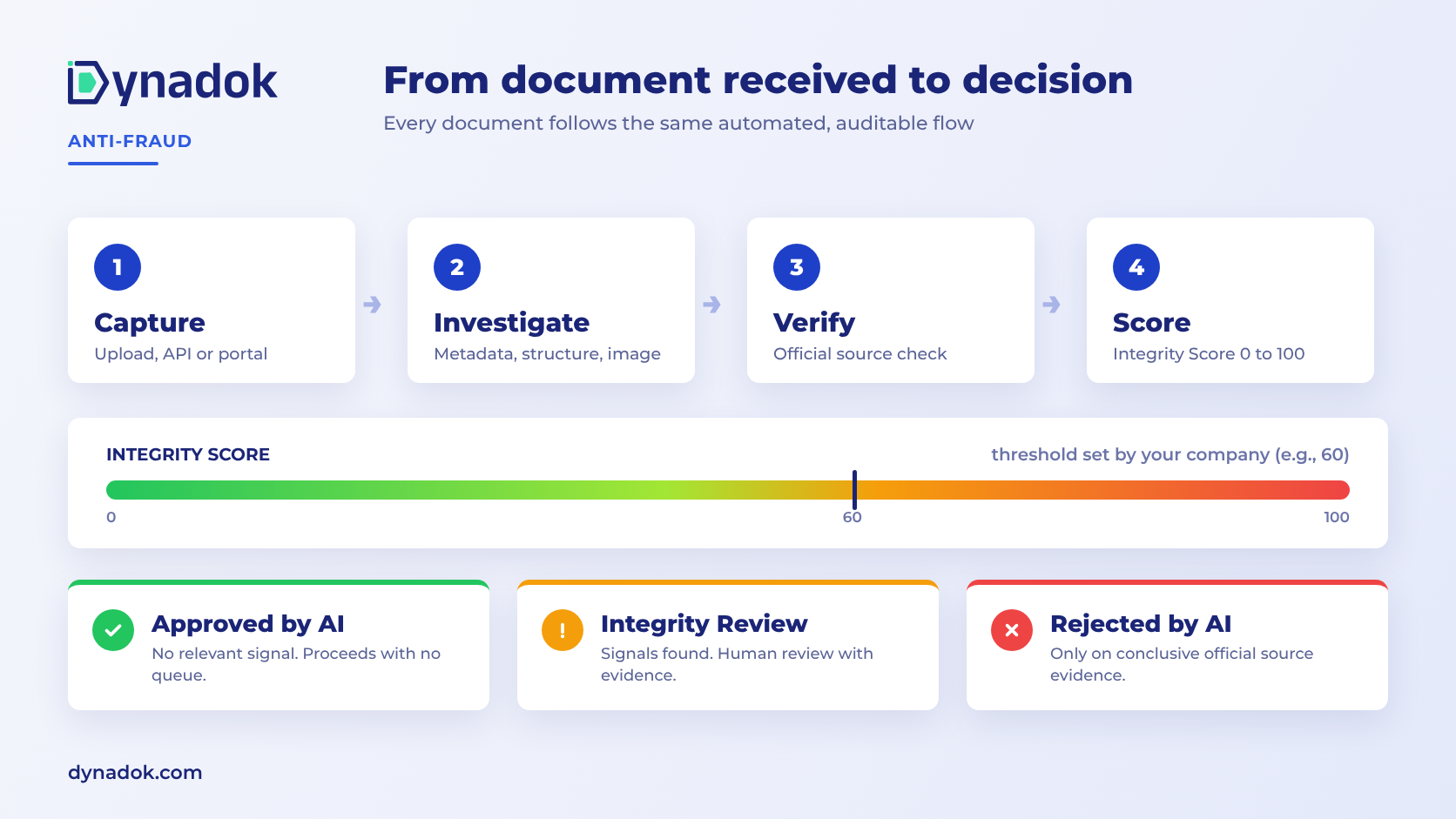
- Capture and classify the document. Receive the file through upload, API or a submission portal and let the AI identify the document type. Classification decides which checks apply: a computer-generated PDF needs structural analysis, while a photo or scan needs image forensics.
- Inspect file origin and metadata. Examine how, when and with which software the file was created. A medical certificate created in a graphic design program, or a photo without the technical capture data that every camera records, is a strong indicator of fabrication.
- Analyze the internal construction. Read the PDF structure for overlays, such as a white rectangle or an image placed over the original content. If someone covered a value and typed a new one on top, the overlay remains recorded inside the file even when the visual result is perfect.
- Run image forensics on photos and scans. Apply independent readings for texture, recompression marks and color saturation. An edited region tends to appear as an area that is too smooth, carries different compression traces or shows a lighter, uniform patch, and convergence of several readings on the same spot increases confidence.
- Check layout and consistency. Compare the document with the expected template for its type: headers, logos, verification codes, field positions and fonts. Confirm that machine-readable zones and barcodes match the printed data, as NIST SP 800-63A-4 requires.
- Verify the data at the official source. Query the issuer or an authoritative database: a professional licensing board, a government registry, a sanctions list. A visually flawless document with false data is exposed here, because the source returns the true value.
- Consolidate a score and route the case. Combine all signals into an integrity score and compare it with a threshold defined per process. Clean documents are approved automatically, suspicious ones go to human review with the evidence attached, and only conclusive source contradictions lead to automatic rejection.
- Record everything for audit. Store each check, result, score and timestamp in an audit trail. A complete record lets the organization explain every decision to customers, auditors and regulators.
Two design choices separate effective programs from noisy ones. First, the submitter should not be told that the document was flagged, so the fraudster does not learn which technique failed. Second, the absence of a digital signature should be treated as information rather than as a red flag, because ordinary resends (messaging apps, “print to PDF”, phone photos) strip signatures from legitimate files.
How do you choose a document fraud detection approach?
The right document fraud detection approach depends on volume, risk and the types of documents involved. Four approaches dominate the market: manual review, OCR with business rules, identity verification tools focused on selfies and ID cards, and AI document forensics combined with official source verification. Each approach covers a different part of the problem.
| Criterion | Manual review | OCR and rules | Selfie and ID verification tools | AI forensics and source verification |
|---|---|---|---|---|
| Detects digital tampering in PDFs | No | No | Limited to ID documents | Yes, through metadata and internal structure |
| Detects edited regions in photos | Only gross edits | No | Partially | Yes, through texture, recompression and color |
| Confirms data with the issuer | Rarely | No | For some ID documents | Yes, when an official source is available |
| Covers non-identity documents | Yes | Yes | No | Yes |
| Scales to thousands of documents | No | Yes | Yes | Yes |
| Explains the decision with evidence | Depends on the analyst | Rule result only | Score only | Score, flagged region and source result |
Source: own elaboration based on NIST SP 800-63A-4 (2025) and FinCEN (2024).
When evaluating vendors, ask for error rates measured against an independent reference, since NIST SP 800-63A-4 sets DFAR and DFRR targets of 0.1 or less for automated validation. Ask how the system behaves when a document has no official source, how thresholds are configured per process, and whether the result shows the exact region and reason for each alert. A vendor that only returns “suspicious” or “approved” leaves the hardest part of the work to your team.
Integration matters as much as detection. A tool that forces reviewers to switch systems adds friction and gets bypassed. The best results come from solutions that plug into the portal, ERP or onboarding flow the company already uses, which is the model described in the Dynadok document validation API documentation.
What are the most common mistakes in document fraud prevention?
Most failures in document fraud prevention come from treating fraud detection as a visual task. The mistakes below appear repeatedly in operations that rely on manual review or on a single automated check:
- Trusting how a document looks: a tampered file with a perfect layout passes visual review, and the business approves a loan, hire or claim based on false information.
- Checking the file but never the source: synthetic documents with invented data look flawless, so without verification at the issuer they enter the system as valid records.
- Treating every difference as fraud: files are scanned, converted and resent, so a tool that flags every artifact floods reviewers with false positives and buries the real cases.
- Warning the submitter about the suspicion: the fraudster learns which technique failed and returns with an improved version of the same document.
- Using one threshold for every process: an admissions process and a reimbursement flow carry different risks, and a single rule makes one too strict and the other too permissive.
- Sampling instead of checking everything: random sampling guarantees that part of the fraud goes unreviewed, and the ACFE reports a median of 12 months before occupational fraud is detected.
- Keeping no audit trail: without a record of what was checked and why, the organization cannot defend its decisions before auditors, regulators or courts.
The common thread is lack of evidence. A decision based on evidence (which region was flagged, which check failed, what the source returned) is faster to review and easier to defend than a decision based on impression.
How does Dynadok detect document fraud?
Dynadok is an AI-powered document intelligence infrastructure that automates document collection, validation, anti-fraud and decision. The Dynadok anti-fraud layer works on two complementary fronts: a forensic investigation of the file (origin and metadata, internal construction, image texture, recompression marks, color, layout consistency and internal digital signature) and verification of the data directly at official sources, such as professional licensing boards and government databases.
Every signal feeds an Integrity Score from 0 to 100, compared with a threshold that each customer configures per type of analysis. Documents with no relevant signal are approved by the AI, documents with signals go to Integrity Review with the flagged region and the reasons attached, and only conclusive evidence from the official source leads to automatic rejection. Dynadok also issues and queries 27 documents automatically at official sources, including OFAC, UN and EU sanctions lists and politically exposed persons databases.
Dynadok publishes its accuracy with methodology. In a blind human audit of 500 production documents drawn from a population of 394,900, Dynadok reports 95.2% verified accuracy and wrongful approvals of 0.8% (4 cases in 500), while the blind human auditor’s error rate was 9.6%. According to Dynadok, customers reduce validation time by up to 95%. Cássio Lapertosa, IT Director at Emccamp, said the technology “interprets documents by cross-referencing information, much like human analysis.” For a side-by-side view of costs and results, see the comparison between Dynadok automation and manual document validation.
Frequently asked questions about document fraud detection
Can AI detect fake documents?
Yes. AI detects fake documents by examining file metadata, internal structure, image texture, recompression marks and layout, and by checking the claimed data against the issuing source. AI flags the possibility of manipulation with evidence, and a human reviewer makes the final call on suspicious cases.
What is the most commonly forged document?
National ID cards are the most targeted document. The Entrust Cybersecurity Institute 2025 Identity Fraud Report found that national ID cards accounted for 40.8% of document attacks globally, based on data collected between September 2023 and August 2024.
How fast is digital document forgery growing?
Digital document forgery grew 244% year over year according to the Entrust Cybersecurity Institute, and digital forgeries represented 57% of all document fraud in 2024. Sumsub reported a 311% increase in synthetic identity document fraud in North America in the first quarter of 2025.
What is a tampered document?
A tampered document is a legitimate document that was altered after issuance, for example by changing a name, a date, an amount or a test score. Tampering often leaves physical traces in the image, such as a region with texture or compression marks different from the rest of the page.
What is a synthetic identity document?
A synthetic identity document combines real and invented information, often generated with AI, to support an identity that does not exist. Synthetic documents can look flawless, so verification of the data at the issuing source is the most reliable way to expose them.
Does NIST allow automated document validation?
Yes. NIST SP 800-63A-4, finalized in July 2025, lists “Automated document validation processes using appropriate technologies” as an acceptable method for validating identity evidence, alongside visual inspection by trained personnel and cryptographic verification of digital evidence.
What error rates does NIST set for automated document validation?
NIST SP 800-63A-4 states that automated evidence validation technology SHALL meet a document false acceptance rate (DFAR) of 0.1 or less and a document false rejection rate (DFRR) of 0.1 or less. These targets apply to optical capture and document authentication systems.
What did FinCEN warn about AI-generated documents?
FinCEN alert FIN-2024-Alert004, issued on November 13, 2024, warned that criminals use generative AI to create fraudulent identity documents and deepfake media to circumvent identity verification. FinCEN reported an increase in suspicious activity reports describing these schemes.
What are the red flags of a fraudulent identity document?
FinCEN red flags include photos with visual signs of alteration, multiple identity documents that are inconsistent with each other, identity photos matching galleries of AI-generated faces, and device or location data that contradicts the documents. Each red flag justifies additional review.
Is a missing digital signature a sign of fraud?
No. A missing digital signature is not a reliable sign of fraud, because common resends such as messaging apps, “print to PDF” and phone photos remove signatures from legitimate files. A valid signature from a trusted issuer, however, is strong evidence of authenticity.
Should the person who submitted a suspicious document be notified?
No. The alert should stay internal to the review team. Telling the submitter that a document was flagged teaches the fraudster which technique failed, and the next attempt arrives with an improved forgery. The review team decides the next step based on the evidence.
How much does document fraud cost organizations?
The ACFE 2026 Report to the Nations estimates that organizations lose 5% of revenue to fraud each year. The ACFE found a median loss of $104,000 per occupational fraud case, and 20% of the 2,402 cases studied exceeded $1 million in losses.
Which industries are most exposed to document fraud?
Financial services, lending, crypto, healthcare, insurance, education and HR onboarding are highly exposed. Entrust found that crypto platforms accounted for 9.5% of fraud attempts, lending and mortgages 5.4% and traditional banks 5.3%, while Sumsub reported a 384% rise in healthtech fraud attempts in early 2025.
Can manual review catch digital tampering?
Manual review catches gross edits but misses most digital tampering. Metadata, internal PDF layers and recompression traces are invisible on screen, and reviewers checking thousands of files cannot query issuing sources for every case. Manual review works best for the exceptions flagged by automated checks.
What is an integrity score in document fraud detection?
An integrity score is a consolidated number, usually from 0 to 100, that combines the signals of every forensic and source check. The score is compared with a threshold defined per process: below the threshold the document proceeds, above it the document goes to human review.
Does document fraud detection work for non-identity documents?
Yes. Forensic checks on origin, structure and image apply to any document, including bank statements, pay stubs, invoices, medical certificates and corporate certificates. Source verification depends on whether an issuer or authoritative database exists for that document type.
How does AI handle documents that have no official source?
When no official source exists, AI relies on file forensics: origin and metadata, internal construction, texture, recompression, color and layout consistency. Many fabricated medical certificates, for example, are exposed because the file records creation in a graphic design program.
Can document fraud detection integrate with existing systems?
Yes. Modern document fraud detection runs through an API that receives the document where it enters the workflow, such as a portal, ERP or onboarding system, and returns the score, the evidence and the source results with an audit trail, without replacing existing systems.
How accurate is AI document validation?
Accuracy varies by vendor and must be measured with methodology. Dynadok reports 95.2% verified accuracy in a blind human audit of 500 production documents, with 0.8% wrongful approvals. Ask every vendor for error rates measured against an independent reference.
How do I start detecting document fraud in my operation?
Start by mapping which documents drive your highest-risk decisions and which have an official source. Then define thresholds per process and pilot automated checks on real documents. The Dynadok FAQ on document validation explains implementation, integration and security in detail.
Conclusion
Document fraud has moved from the printer to the image editor and to generative AI: digital forgeries already represent 57% of all document fraud, according to Entrust, and visual review cannot see where digital tampering hides. Effective document fraud detection combines file forensics with verification at the issuing source, as NIST SP 800-63A-4 and FinCEN guidance point out, and keeps humans focused on the cases that carry real evidence. To see the Dynadok anti-fraud analysis running on a real document from your process, request a demo at dynadok.com/en.
How to cite this article
ABNT: DYNADOK. Document Fraud Detection: How to Spot Forged and Tampered Documents with AI. Dynadok, 22 Nov. 2026. Available at: https://dynadok.com/en/document-fraud-detection-ai/. Accessed on: 22 Nov. 2026.
APA: Dynadok. (2026, November 22). Document fraud detection: How to spot forged and tampered documents with AI. Dynadok. https://dynadok.com/en/document-fraud-detection-ai/
References
BALLARD SPAHR. FinCEN alert: fraud schemes using generative artificial intelligence to circumvent financial institutions’ identity verification, authentication and due diligence controls. Consumer Finance Monitor, 20 Nov. 2024. Available at: https://www.consumerfinancemonitor.com/2024/11/20/fincen-alert-fraud-schemes-using-generative-artificial-intelligence-to-circumvent-financial-institutions-identity-verification-authentication-and-due-diligence-controls/. Accessed on: 22 Nov. 2026.
COHN, Michael. Organizations lose 5% to fraud each year. Accounting Today, 12 May 2026. Available at: https://www.accountingtoday.com/news/organizations-lose-5-to-fraud-each-year. Accessed on: 22 Nov. 2026.
CROWDFUND INSIDER. US FTC reports $15.9 billion in consumer fraud losses in past year. Crowdfund Insider, Mar. 2026. Available at: https://www.crowdfundinsider.com/2026/03/269398-us-ftc-reports-15-9-billion-in-consumer-fraud-losses-in-past-year/. Accessed on: 22 Nov. 2026.
DELOITTE CENTER FOR FINANCIAL SERVICES. Generative AI is expected to magnify the risk of deepfakes and other fraud in banking. Deloitte Insights, 29 May 2024. Available at: https://www.deloitte.com/us/en/insights/industry/financial-services/deepfake-banking-fraud-risk-on-the-rise.html. Accessed on: 22 Nov. 2026.
DYNADOK. AI Info: what Dynadok is, how it works and who it is for. Dynadok, 2026. Available at: https://dynadok.com/en/dynadok-ai-info/. Accessed on: 22 Nov. 2026.
DYNADOK. Antifraude documental. Dynadok, 2026. Available at: https://dynadok.com/anti-fraude/. Accessed on: 22 Nov. 2026.
DYNADOK. Qual é a assertividade da IA da Dynadok na validação de documentos? Dynadok, Aug. 2026. Available at: https://dynadok.com/assertividade-ia-dynadok-validacao-documentos/. Accessed on: 22 Nov. 2026.
ENTRUST. Deepfake attacks strike every five minutes amid 244% surge in digital document forgeries. Business Wire, 18 Nov. 2024. Available at: https://www.businesswire.com/news/home/20241118521944/en/Deepfake-Attacks-Strike-Every-Five-Minutes-Amid-244-Surge-in-Digital-Document-Forgeries. Accessed on: 22 Nov. 2026.
FINANCIAL CRIMES ENFORCEMENT NETWORK (FINCEN). FinCEN issues alert on fraud schemes involving deepfake media targeting financial institutions. Washington: U.S. Department of the Treasury, 13 Nov. 2024. Available at: https://fincen.gov/news/news-releases/fincen-issues-alert-fraud-schemes-involving-deepfake-media-targeting-financial. Accessed on: 22 Nov. 2026.
NATIONAL INSTITUTE OF STANDARDS AND TECHNOLOGY (NIST). SP 800-63A-4: Digital Identity Guidelines: Identity Proofing and Enrollment. Gaithersburg: NIST, July 2025. Available at: https://pages.nist.gov/800-63-4/sp800-63a.html. Accessed on: 22 Nov. 2026.
SECURITYWEEK. FBI: cybercrime losses neared $21 billion in 2025. SecurityWeek, Apr. 2026. Available at: https://www.securityweek.com/fbi-cybercrime-losses-neared-21-billion-in-2025/amp/. Accessed on: 22 Nov. 2026.
SUMSUB. Synthetic identity document fraud surges 300% in the U.S.: Sumsub warns e-commerce, healthtech and fintech at risk. Sumsub, 12 June 2025. Available at: https://sumsub.com/newsroom/synthetic-identity-document-fraud-surges-300-in-the-u-s-sumsub-warns-e-commerce-healthtech-and-fintech-at-risk. Accessed on: 22 Nov. 2026.